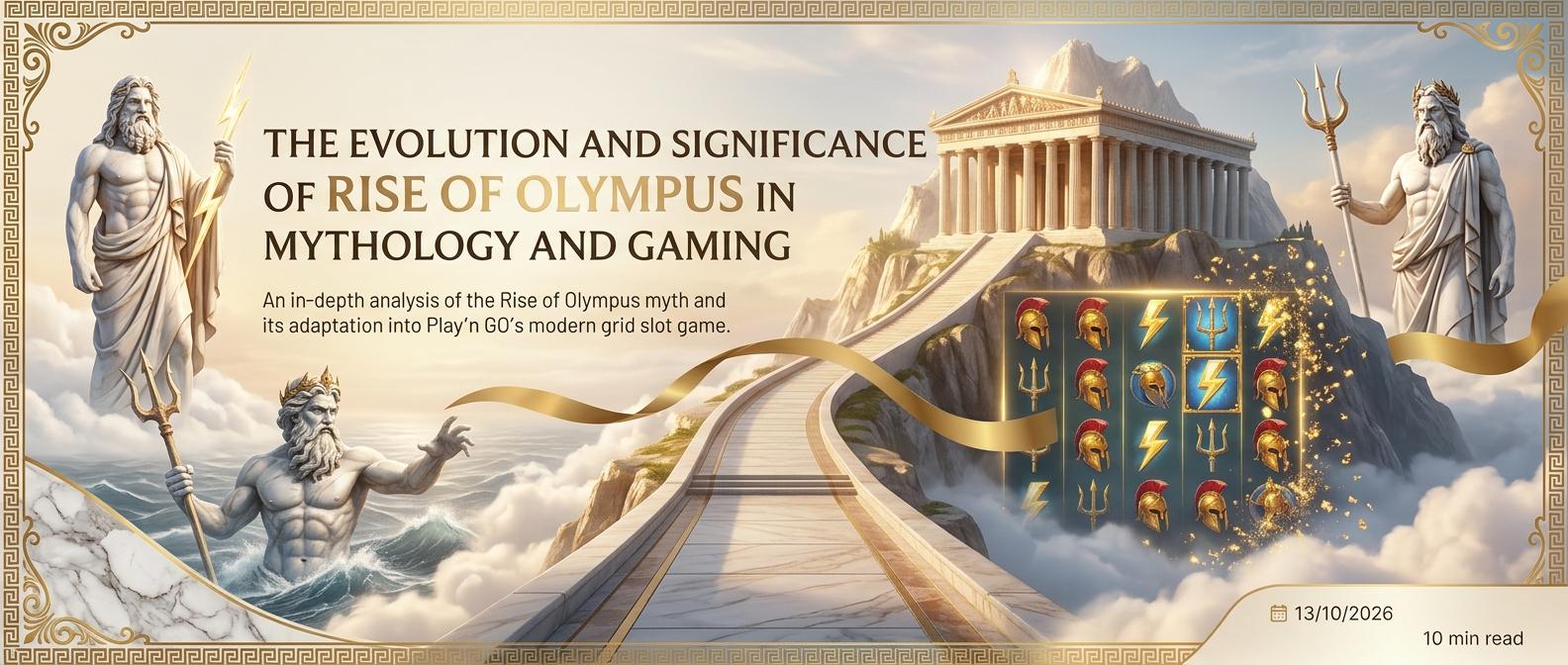
The Evolution and Significance of Rise of Olympus in Mythology and Gaming
An in-depth analysis of the Rise of Olympus myth and its adaptation into Play’n GO's modern grid slot game.
In the contemporary landscape of mythological exploration, few concepts capture the imagination as vividly as the "Rise of Olympus." This narrative arc—spanning from the primordial chaos of early creation to the structured hegemony of the Olympian pantheon—serves as a foundational pillar for Western literary traditions and modern cultural archetypes. To understand the Rise of Olympus is to examine not merely a collection of myths, but an intricate socio-political allegory regarding power, lineage, and the transition from raw nature to organized civilization.
The ascent toward Olympian dominance begins in the era of the Protogenoi—the primordial deities who personified the fundamental forces of the universe. In this initial stage, existence was characterized by Chaos, a state of formless void and unorganized potentiality. From this vacuum emerged Gaia (Earth), Tartarus (the Abyss), and Eros (Desire).
The transition from these elemental beings to structured deities represents the first major "rise." It was during this period that the universe began to take shape, moving away from abstract forces toward defined entities capable of interaction, conflict, and governance. This era established the necessary infrastructure for what would eventually become the Olympian order: a world where geography had boundaries and life possessed agency.
The most pivotal moment in the Rise of Olympus is undoubtedly the Titanomachy—the generational war between the Titans, led by Cronus, and the burgeoning forces of the Olympians, spearheaded by Zeus. This conflict serves as a profound historical metaphor for the shift from autocratic rule to institutionalized authority.
Cronus represented an older form of power: cyclical, heavy-handed, and exclusionary. By overthrowing his father Uranus and subsequently being challenged by his children, Cronus embodied the dangers of unchecked hegemony. The victory of Zeus and his siblings marked a revolutionary change in cosmic governance. It was not merely a change of leadership but a transformation of method. Olympus introduced a system where power was distributed among various spheres—war (Ares), wisdom (Athena), the sea (Poseidon), and agriculture (Demeter)—creating a multifaceted social structure that mirrored human societal development.
Once established, the Rise of Olympus culminated in the creation of an organized hierarchy. Zeus ascended as the sovereign ruler, establishing a "law" for the gods—a concept that resonated deeply with the Greeks' own burgeoning city-states. This period saw the transition from raw survival to cultural sophistication.
Under the Olympian regime, the divine realm became a mirror of human civilization:
In the modern era, "Rise of Olympus" continues to resonate as a powerful motif in literature, gaming, and cinematic arts. It serves as an enduring symbol for any narrative involving the overthrow of old systems by new ideologies or the struggle of individuals against overwhelming systemic forces.
Whether analyzed through the lens of classical archaeology or contemporary creative storytelling, the Rise of Olympus remains a testament to humanity's fascination with power dynamics. It reminds us that civilization is built upon conflict, and order is often forged in the crucible of upheaval. By studying this mythological ascent, we gain deeper insight into our own societal structures and the perennial human desire to organize the chaos of existence into something enduring and magnificent.
In the contemporary landscape of digital entertainment and online gaming, few themes have remained as enduringly captivating as Greek mythology. Among the myriad of titles released within this genre, Rise of Olympus stands out as a premier example of how sophisticated mechanics can be integrated with classical lore to create an immersive user experience. Developed by the renowned studio Play’n GO and launched in 2018, this title redefined expectations for grid-based slot dynamics through its innovative "cascading" system and high-volatility features.
Unlike conventional slot machines that rely on fixed linear paths to determine winning combinations, Rise of Olympus utilizes a sophisticated 5x5 grid structure based on connected symbols. This design choice shifts the focus from horizontal or diagonal alignment toward spatial clusters. Central to this experience is the "Cascading" mechanic: when a winning combination occurs, the corresponding symbols are removed from the board, allowing new symbols to tumble into the vacated spaces.
This continuous flow creates an environment where a single initial spin can trigger a sequence of consecutive wins. This "avalanche effect" not only heightens the visual spectacle but also significantly enhances the potential for compounding rewards within a single round of play.
The thematic integrity of Rise of Olympus is reinforced by its inclusion of three primary deities—Zeus, Poseidon, and Hades—each contributing unique mechanics to the gameplay experience. These features are primarily manifested through two core systems: "Hand of God" and "Wrath of Olympus."
These mechanisms serve as dynamic modifiers that can drastically alter the outcome of a spin. Furthermore, the game incorporates several high-value progression tools:
From a technical perspective, Rise of Olympus is characterized by its high volatility profile. This means that while wins may occur less frequently than in low-volatility games, they possess the potential for significant magnitude. The original version boasts a theoretical Return to Player (RTP) of up to 96.50%, with a maximum prize potential reaching 5,000x the initial wager.
To facilitate a comprehensive understanding of these complex mechanics without financial risk, Play’n GO offers a demo version of Rise of Olympus. This educational tool allows players to navigate the 5x5 grid and experience the "Wrath of Olympus" meter firsthand using virtual credits. By engaging with the demo, users can master the nuances of symbol connectivity and deity-driven powers—such as those wielded by Zeus, Poseidon, and Hades—before committing to a live environment.